Medea in Greece
Event Details
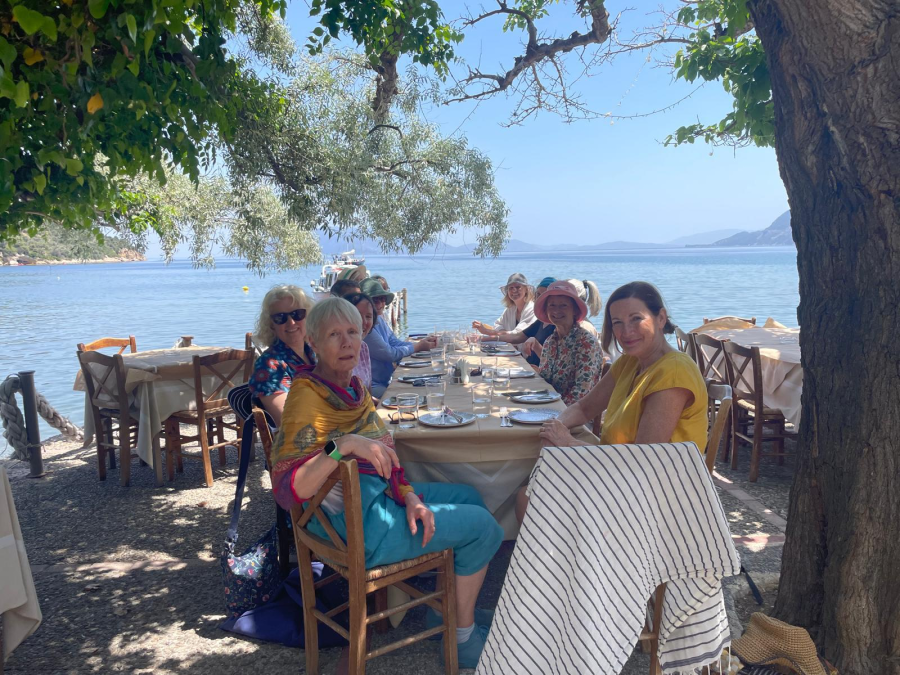
We are now planning for 2027 and our sixth visit to the enchanting island of Agistri in the Saronic Gulf, where we read the classical literature of Ancient Greece. Over three week-long studies, we will study Homer’s Odyssey, Euripides’ Medea, and The Bacchae by Euripides with Aristophanes’ The Birds. Reading these extraordinary and enduring works in the midst of this land and seascape can only deepen and enrich our experience of the texts. Do take a look at our ‘Gallery’ page and below to see photos from our previous studies on the island.

First performed in 431BCE, as the third – and only surviving – part of a trilogy, Medea remains one of the most-produced Greek tragedies. It is an exploration of the roles of men and women, both actual and ideal, but is it also an argument for sexual equality?
In a monologue addressed to the Chorus – our moral conscience – Medea produces a memorable assertion about a gap in understanding between men and women. She tells us that men
“. . . say that we live a life free from danger at home, while they fight with the spear. They are so wrong! For I would rather take my stand three times with a shield in battle than once give birth to a child.“
We know that in Athens, women were not permitted to exercise legal, economic or social autonomy. How can we therefore explain the fact that the tragic plays that survive often portray them as having influential social and moral force? Can we think of Euripides in particular as a kind of proto-feminist? There are many occasions in Medea and other of his plays when his characters express damning general criticisms of women. Could a ‘proto-feminist’ be also a misogynist?
Medea has already committed two murders, both of them in service of Jason – who subsequently abandons her in favour of a younger and richer woman. The precise details of her plotting of revenge on him are so gruesome that we may struggle to feel sympathy for her. If one wanted to write a play about ‘proto-feminism’, would one not try to make the central character more engaging?
But Euripides is not trying to create a sympathetic character to whom we can relate in an easy, comfortable way. His aim is to confront us with something truly shocking and to explore issues which we might choose to avoid. It is possible to compare Medea with Oedipus, even though the contrasts are obvious: one acts from good intentions and has no idea of the terrible deeds he has done, whereas the other acts from malign intent and knows exactly what terrible things she has done and intends to do. The similarities lie in the way they both dominate their plays, being hardly ever off stage, and act as chief protagonists who determine the course of events, by their bold actions confronting things we might prefer to turn away from. And perhaps this is why Euripides can appear so modern to us. Terrible things breed in broken hearts.
JOINING DETAILS:
- Seven-day study of Euripides’ Medea on the island of Agistri: Thursday 29 April-Thursday 6 May 2027
- Facilitated by Toby Brothers, Jane Wymark and Keith Fosbrook
- Cost: £950 for the Salon study, to include a preparatory meeting in April (on Zoom, date to be confirmed), background materials and opening notes. Opening notes will be sent after registration.
- The study programme will run for four to five hours per day for five days, with one day left open and travel days at each end (arriving by 17.00 local time on Day 1 and leaving by 09.00 on Day 8). There will be opportunities for other optional activities including kayaking adventures, trips to local sights, or pure relaxation.
- Before you arrive on Agistri we will ask you to read Medea, we recommend the Norton Critical Edition, translated and edited by Sheila Murnaghan, ISBN13: 9780393265453.
- Payment: we ask for an initial (non-returnable) deposit of £100 on registration to secure your place using the booking form below. The balance of £850 will be payable by bank transfer (we will supply bank details), due by 31 January 2027.
- Refunds: please note that any refunds will be entirely at the discretion of the London Literary Salon, dependent on our ability to fill the place, and will be subject to a charge to cover our administration costs.
- Waiting list: if the study sells out early we will maintain a waiting list as we sometimes find that people have to withdraw for reasons beyond their control.
BOOKING & ENQUIRIES:
To ask questions please email us at litsalon@gmail.com using ‘Agistri 2027 – Medea’ as the subject line.
ACCOMMODATION COSTS:
Room and half board (breakfast and dinner each day) will be arranged with the hotel by the individual participant and paid for directly to them. A deposit to cover accommodation for two nights will be required by the hotel on booking. We will send you full contact details for payment on registration. We have set out the anticipated charges below, but these may be subject to change at the time of booking at the discretion of the hotel.
Accommodation prices per night at the hotel – Rosy’s Little Village – are estimated below on the basis of figures available in July 2026 but may be subject to small changes:
- Single – €80 per night plus half board (breakfast and dinner) estimated at €55 per day
- Double – €90 per night plus half board (breakfast and dinner) estimated at €55 per person per day
- Family room for two people – €100 per night plus half board (breakfast and dinner) estimated at €55 per person per day
- Family room for three people – €110 per night plus half board (breakfast and dinner) estimated at €55 per person per day
Please consider sharing accommodation with another participant as this helps us to ensure that everyone can stay on site; double and triple rooms offer split levels and so allow sharers a significant degree of personal privacy.
OTHER ADDITIONAL COSTS TO BUDGET FOR:
Flights to Athens: when booking please make sure you can arrive at the port of Piraeus by 15.00 local time on the first day of your study to catch the ferry. We will not be meeting formally on the final day of the study, so you have choices about your return (ferries are frequent and the travel time to Piraeus is one hour) but participants normally leave Agistri at around 09.00.
Ferry to Agistri: normally around €14 each way.
Incidental expenses: drinks, lunches, extra trips etc.
Insurance: we hope this will be entirely redundant, but we ask you to arrange your own travel and health insurance to protect you in case of anything untoward happening. We will ask you for details of the insurance provider and reference number, as well as your mobile phone number and details of next of kin to add to our (confidential) records for use during the study.